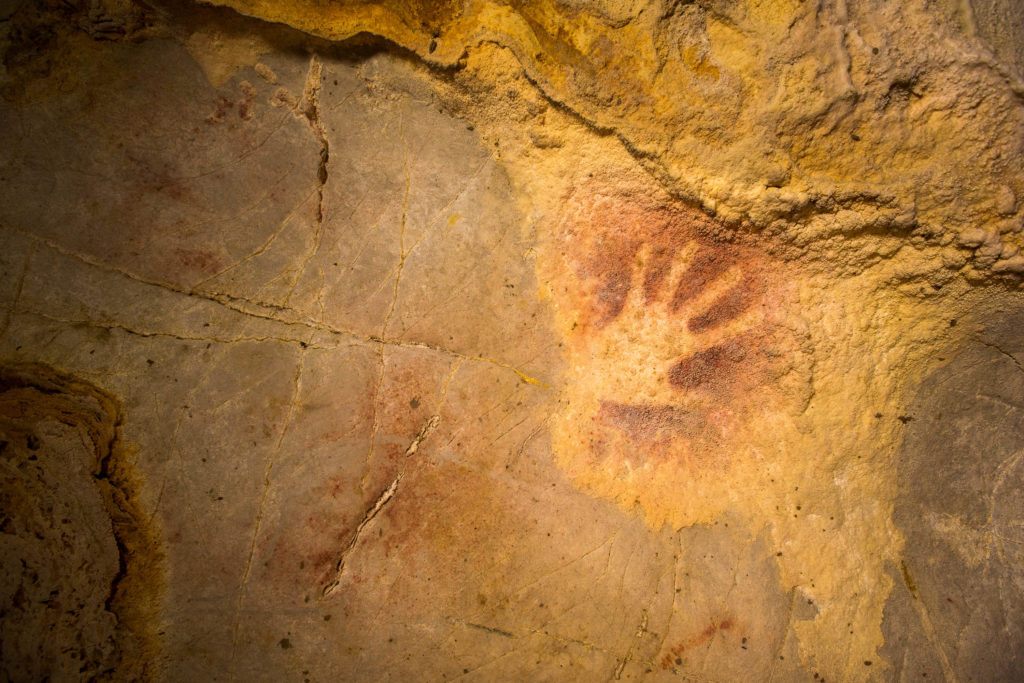
Above, 37,500 year old handprint from El Castillo Cave in Spain. How can we be certain of how old this image is?
In January 2026, Adhi Agus Oktaviana, Maxime Aubert, and colleagues published a uranium-thorium (U-Th) minimum age of 67,800 years for a hand stencil from Liang Metanduno on Muna Island, Sulawesi, making it the oldest dated rock art in the world (Oktaviana et al., Nature, 2026). That date is older than the earliest securely documented modern humans outside of Africa. The publication revives a debate about the technique the team used to establish that astounding age.
U-Th Dating and Its Limits
If you are not familiar with how Uranium-Thorium (U-Th) dating works, we have a full explainer on it and other dating techniques here. The short version: researchers date the calcium carbonate (calcite) that forms over paintings on cave walls, acting as a minimum-age clock. The art beneath must be at least as old as the crust above it.
The method can reach back 500,000 years and requires no organic material. But it carries a known vulnerability: calcite on cave walls is not always chemically sealed from the environment. Uranium, which the dating clock depends on measuring, can leach out over time. When it does, the calculated age skews older than reality.
The authors of the Muna Island paper acknowledge this directly. They argue their use of laser-ablation U-series imaging, a higher-resolution technique that samples at sub-millimeter scale across multiple points, allowed them to identify and exclude zones of uranium mobility, and that the consistency of results across those measurements confirms the calcite behaved as a closed system.
This Debate Has History
The reliability of U-Th dating for cave art has been contested before. In 2018, Dirk Hoffmann, Alistair Pike, and colleagues published U-Th dates for paintings in three Spanish caves (La Pasiega, Maltravieso, and Ardales) with minimum ages exceeding 65,000 years, implying Neanderthal authorship since scientific consensu is that modern humans did not reach Western Europe until roughly 40,000 years ago (Hoffmann et al., Science, 2018). Randall White and colleagues published a formal rebuttal arguing that uranium leaching in the dated calcite could account for the anomalous ages (White et al., Journal of Human Evolution, 2020), with Pearce and Bonneau and Slimak and colleagues raising similar concerns. The Hoffmann and Pike team stood by their results, and the debate remains unresolved. A different explanation for the origin of very old art is that we simply do not fully understand how and when modern humans came to Europe.
The Critique of the Indonesian Dates
This spring, French researcher Georges Sauvet published a pointed challenge in AOJ Historical Archaeology and Anthropological Exploration (2026), arguing that U-Th dating of wall-surface calcite carries a systematic bias toward overestimation that is difficult to detect. His concern is not with the method applied to large pristine stalagmites deep in caves, where it is well-validated, but with the thin deposits directly overlying paintings.
Sauvet points to an anomaly in the Sulawesi data. At Leang Tedongnge, where a pig painting was dated to at least 45,500 years ago (Brumm et al., Science Advances, 2021), four separate slices sampled through the thickness of the overlying calcite returned nearly identical ages. Karst geology is often genuinely strange, and calcite-depositing water can behave in unexpected ways, so unusual layering patterns are not unheard of. But Sauvet argues the easiest explanation is that uranium leaching affected the full thickness of the deposit uniformly, making every slice appear equally old, and equally inflated.
The broader methodological concern is this: the standard check for uranium mobility is to verify that ages progress in stratigraphic order through the calcite layers. If leaching is uniform across the deposit, the ages will still appear in order, but the returned dates will be off.
The Counter-Arguments
The Griffith University team argues that laser-ablation imaging maps uranium distribution spatially before sampling zones are selected, and that multiple independent measurements from different regions of the same calcite would produce scatter, not consistency, if uranium had migrated.
Most compellingly, the totality of Indonesian dates represents multiple caves, multiple sites, multiple sampling trips, all gathered over years of field work. All of the data returns very old ages across the Maros-Pangkep karst and now into southeastern Sulawesi. Systematic leaching would be expected to produce local and sporadic results, not the coherent sequence that has emerged across the region after years of research.
Does This Matter?
No one is suggesting that the Sulawesi art (or the Spanish art for that matter) is not extraordinarily old. But conclusions from those ages are important.
The Sulawesi dates have been used to argue that fully modern symbolic cognition was present in human populations moving through Southeast Asia far earlier than the European Paleolithic record alone would suggest.
The dates are well aligned with the African record, where we know from multiple dating techniques and many sites that humans began using red ochre more than 230,000 years ago (Barham, Current Anthropology, 2002), began making paint 100,000 years ago (Henshilwood et al., Science, 2011), and were producing abstract engravings 77,000 years ago (Henshilwood, d’Errico, and Watts, Journal of Human Evolution, 2009). A capacity for symbolic behavior reaching back 67,800 years in Sulawesi fits within that trajectory.
Extremely old Spanish dates fit into that trajectory as well and might prompt a rethinking of modern human occupation of the Iberian Peninsula.
In general, it is always good to remember that these sites are all small slices of the past. Individually, each is an accident of preservation. It is a small miracle that they exist at all.
The question about the accuracy of U-Th dating in thin calcite deposits remains an open debate. No doubt the technique will be further refined and produce more and better results that further refine the view of our collective past.
Key References
- Barham, L.S. (2002). Systematic pigment use in the Middle Pleistocene of South-Central Africa. Current Anthropology, 43(1), 181–190. doi:10.1086/338292
- Marean, C.W. et al. (2007). Early human use of marine resources and pigment in South Africa during the Middle Pleistocene. Nature, 449, 905–908. doi:10.1038/nature06204
- Henshilwood, C.S., d’Errico, F., and Watts, I. (2009). Engraved ochres from the Middle Stone Age levels at Blombos Cave, South Africa. Journal of Human Evolution, 57(1), 27–47. doi:10.1016/j.jhevol.2009.01.005
- Henshilwood, C.S., d’Errico, F., van Niekerk, K.L. et al. (2011). A 100,000-year-old ochre-processing workshop at Blombos Cave, South Africa. Science, 334(6053), 219–222. doi:10.1126/science.1211535
- Hoffmann, D.L. et al. (2018). U-Th dating of carbonate crusts reveals Neandertal origin of Iberian cave art. Science, 359, 912–915. doi:10.1126/science.aap7778
- White, R. et al. (2020). Still no archaeological evidence that Neanderthals created Iberian cave art. Journal of Human Evolution, 144, 102640. doi:10.1016/j.jhevol.2019.102640
- Brumm, A. et al. (2021). Oldest cave art found in Sulawesi. Science Advances, 7, eabd4648. doi:10.1126/sciadv.abd4648
- Aubert, M. et al. (2024). Narrative cave art in Indonesia by 51,200 years ago. Nature, 631, 308–313. doi:10.1038/s41586-024-07541-7
- Oktaviana, A.A. et al. (2026). Rock art from at least 67,800 years ago in Sulawesi. Nature, 650, 652–656. doi:10.1038/s41586-025-09968-y
- Sauvet, G. (2026). Uranium-thorium dating: the race towards the earliest rock art. AOJ Historical Archaeology and Anthropological Exploration, 2(1), 13–15.